skip to main |
skip to sidebar
If you've ever wondered where that cold went, the one you had when you were a child, the one that moved from your throat to your lungs to your head and gave you nights that lasted an aeon because you couldn't breathe and your throat hurt, and then you had to cough and you realised that your throat really hadn't been hurting at all, because the cough made it hurt so much more... I've got it. I'm winning the battle, but the end is some distance yet.
So, instead of working – I just can't think clearly when my brain is starved of oxygen – and going to the gym, I have been spinning. It's almost exercise, right? My feet are moving. The ounce of pygora cloud from Terry at Rainbow Yarns Northwest I posted about some time back has become this:
 That's 120m of soft, shiny thickish laceweight. Four ounces of the premium dark grey roving (70% pygora, 30% merino) became 411m of slightly thicker laceweight:
 Spinning these two yarns was another of those learning experiences. Spun a sort of backward supported longdraw (fibre in my left hand drawing back as the twist enters it while my right hand pinches to stop twist now and then to allow the developing singles to thin as my left hand moves back), the cloud almost spun itself; the smooth glossy fibres just slipped neatly together to become the singles.
The grey was different. Very different. There's been some discussion of the difference between roving and top on the Ravelry groups, made more complex by the difference between UK and US terminology. This was roving in the US sense: basically a carded prep in which the fibres are only roughly parallel to one another, and may be of different lengths. (If combed, this roving becomes top in which all the fibres are truly parallel and are generally of more uniform length.) The Merino in the roving adds elasticity and bounce, and flows differently into the singles. I tried to match the WPI of the stuff I got from the cloud, but found it difficult as this really did want to be a thicker yarn, plus it bloomed beautifully after washing and whacking. The end result is a little thicker, but not badly so and I think the two together will be a top-down triangular shawl, dark grey with a white strip of finer lace (I'm thinking something Estonian with nupps) about 2/3 of the way down.
I've just started the last of the stuff from Terry, a beautiful blue 80% pygora/20% silk batt. To prolong the pleasure (I really do like this pygora stuff) I've decided to spin it as thin as I can.
 It's perhaps a little thinner than it looks there, although I do have small fingers :-) It's 60-65wpi. I wonder how much yarn I'll get out of 2.4oz?
 What you can't see (well, you can, but it's not obvious) is that I'm spinning that on the high-speed bobbin and the high-speed whorl that I bought last week for the Schacht. Not the highest high-speed bobbin, but it's faster than the fastest shipped with the wheel. I'm getting better at this.
There's also been knitting. The Tuesday Spinners and Cake-eaters are running an optional group project this year: knit a Swallowtail Shawl (pattern available free here). Some members have never knitted lace before, so even in purchased yarn this is a challenge. Others are spinning the yarn as well. In one of my dyeing experiments I painted a 1oz braid of tussah a beautiful dark plum colour, thinking it would do nicely for the shawl. I rinsed it thoroughly, dried it and spun it to roughly the same wpi as the marisilk/seasilk I'd used for my first Swallowtail. When I washed the yarn in Dreft (a detergent)... it bled. It bled to the point that it became a pale grey-blue skein of silk: it lost ALL the red. I was horrified. Worse, I'd not got quite enough length from the braid, so I needed more. I spun another 30g and spent several hours researching silk dyeing online. Recommendations included soaking even longer than overnight; treating all silk to remove sericin before dyeing; using higher concentrations of dye and pure vinegar, not water, to dilute it; heating for longer and allowing the silk to cool in the dye overnight. I took the new skein and the old skein and did all of it. This time I used a dyebath instead of handpainting, and it was thrilling to watch the colour density of the liquid decrease as the silk took the colour. The end result is two skeins of red silk, one very slightly darker than the other. I'd hoped for scarlet (that's what the test paper showed), but it's a blood red, the red of beef cooked 'blue'. I decided to use the variation in colour as a design feature, changing colour at the start of the lily of the valley pattern, which is where I am now:
 The difference is more subtle than I'd expected, so I'm glad the change in pattern highlights it. I wanted to learn something else new from this, so I've taken the opportunity to try beading using a crochet hook (8/0 beads and a 0.6mm hook). It's easier than I'd imagined and quite effective although I'm not sure I'll wear it. Next decision comes at the end of the second LoV repeat: I want to go back to the darker red. I could just finish the shawl in it, or perhaps not - I'm not sure there's enough. I am tempted to add a single repeat of another Estonian lace pattern, then revert to the brighter red for the edging. Decisions, decisions.
You must be cold. Let's get moving.
Ahead of us is the secondhand book fair under Waterloo Bridge. Unfortunately I've found that, like some cakes, it looks better than it is. Only worth the delay if it's raining, which it isn't. Up the steps onto the bridge, remembering the impact of Anthony Gormley's Event Horizon in 2007 (unfortunately I didn't have a camera with me that day). I love the reminder to look around, to notice the present that surrounds me rather than march along, nose to the pavement and eyes dwelling inwardly on the past or future. Cherish the unexpected!
 Looking west from the bridge there's a good view of the London Eye transfixed by a beam, er, the Clock Tower of the Palace of Westminster aka the Houses of Parliament. Past the Imax cinema, past Waterloo Station and dive into Leake St, which is now a tunnel under the train tracks running south and west from Waterloo.

(That's the other end, on Lower Marsh Street.) The last time we walked here the walls were covered with artistic, elegant, witty political and social comments. This time it's just tags – some artistic, some not – with artists still at work in an atmosphere thick with spray solvents.
Lower Marsh Street is the home of iKnit, which is why we're here, but unfortunately they're out of the Devon Cashmere. Or rather, it's just as well, because it is incredibly expensive as well as incredibly soft. Better luck next time?
Pause for thought. Where next? No idea, but perhaps it's time to head for the north bank. From Westminster Bridge there's a good view back east along the river
 There's a better view of the Eye and the Greater London Council building aka County Hall, which is almost directly across the Thames from the Palace of Westminster (ideally situated for the battles that took place when Margaret Thatcher decided to take Ken Livingstone and the Labour-dominated London Council down).
We head east along the Victoria Embankment completed in 1870, part of the London sewage system by Joseph Bazalgette. Pass the Battle of Britain memorial, unveiled in 2005:


My feelings on viewing memorials are uncomfortably mixed. The sense of 'noble sacrifice' is almost perfectly countered by awareness of the suffering by all concerned and lingering despair that time and time and time again, the best and brightest of any and all nations will die for what may – or may not be – a noble cause. There must be a better way. Anyway...
This is more cheering:
 That's the base of a Victoria Embankment lamp-post, just because I love grotesquely belligerent dolphins. If I were forced to coil like that I lay odds my eyes would bulge, too. Beyond it is an elegantly poised and polished sphinx's bottom defending London's Cleopatra's Needle (nothing to do with Cleopatra, it was created roughly 1000 years before her time) from all comers. Yes, the sphinxes (there's another on the other side) were installed the wrong way around: they're staring at the obelisk instead of staring at us and anyone else who threatened it. Not that their protection was much use, as evinced by the inscription commemorating those who brought the obelisk to London.

'Through the patriotic zeal of Erasmus Wilson FRS this obelisk was brought from Alexandria...'
He read that aloud as 'Through the Victorian love of stealing artefacts from ancient civilisations this obelisk was brought...', which occasioned a surprised look from the people beside us.
We sat on a bench supported by ornately wingéd sphinxes in a Victorian style and considered our options for 5 minutes before deciding to head for Covent Garden to investigate backpacks (that leather bag is incredibly uncomfortable at this point) and other outdoor gear at Ellis Brigham, with an eye open for a leather jacket for him. The Perfect Jacket has been on The List of Unattainable Objects for about four years. Dive up Savoy Street and we're there. I astonish the nice chap in Ellis Brigham by emptying my handbag into a new daypack even before I pay for it, tendering the old bag for the rubbish as I offer my card in payment. Light as a feather (alright, that's an exaggeration) we put all valuables in the front pockets of our jeans and head toward Neal Street through the crowds in Covent Garden.

Hence the cautions about pickpockets. But it was worth it, because we found THE JACKET in Neal Street. A perfect jeans jacket in every regard, made of black leather. He looked at home in it as soon as he put it on.
I was so pleased for him that I swear it had completely slipped my mind that there's a heffalump trap where Neal Street opens onto Shaftesbury Avenue.

Just as well I'd bought a proper daypack. I should specify that I only buy books, not horrendously expensive plastic models. But I do buy a lot of books.
It's getting dark when we emerge into the street again, but it's not late enough to think about eating. What next? I suggest the Apple Store in Regent Street, as I'm thinking about upgrading my work machine.

So it's west through Soho as the lights brighten against the sky. It looks tawdry in daylight and I suspect it can get downright nasty late at night, but I do like this place in the early evening as people flow along the streets to eddy and swirl in front of pubs and popular bars.

I stop briefly at the south end to take a picture, then we settle into a long covet in the Apple store. It's almost dark when I decide I cannot decide anything surrounded by white and silver sirens singing of speed and power and unbelievable (literally) increases in my creative ability.
It's too dark to take spontaneous photos. Here's the last outdoor attempt of the day; I think it's the steeple of All Souls at the head of Regent Street.

These day-long expeditions traditionally finish at Strada in Exmouth Market. The food is decent, the wine list is surprisingly varied, and the desserts are perfectly justifiable after a good walk. So we head northeast navigating by feel rather than fact. I've noticed that our companionable wrangling about which way to turn (or not) at every second street corner disconcerts anybody walking with us, but it's all good fun as far as we're concerned. It's not as though we have to take the most direct route: we do this to find the unexpected. Eventually we always end up approaching the Mount Pleasant Postal Sorting Office and from there we could (almost) walk blindfolded.
Doesn't it feel good to sit down?
Two or so hours later it's time to walk north to King's Cross where we catch the Tube north, remembering one particularly memorable day a year or so ago, when this last stage of the journey was an adventure all by itself. We now check for engineering works on the Underground before we travel, lest we once more end up walking from Golders Green to Finchley, then from Woodside Green to Totteridge & Whetstone.
I'd have had a second dessert if I'd known...

I'd show you, but why would you want to see a picture of rain? Just shut your eyes, hold a melting icecube over your head, and imagine you're in England. I suggest we go for a walk. Just a minute while I get my gloves...
 Probably my fastest knit ever, started Jan 19, finished Jan 22 and that includes unpicking a join at the wrist of one glove, picking up the stitches on the palm and knitting back to the wrist taking care this time to make the cables twist the right way. Pattern is Fetching with an additional cable on the wrist and on the hand (the pattern as written was a little short), 6 rows in the thumbs, and careful use of a standard slipped-stitch cast-off to ensure the top is less likely to stretch wide and catch the breeze. In my own handspun :-) Red Maple, an alpaca/wool/angora blend bought years ago from the Woolen Rabbit. 3-ply that I thought was over-twisted until I put these on: it's soft and getting softer as the angora halo develops, yet I think it's firm enough to wear well.
Let's go to London last Saturday, when the sun was shining. We'll drive into North London and catch the Tube.

Not that one, it's heading further out...

There. Imagine thumps, rocking back and forth, rattles, the roar of steel wheels on steel rails. You can sit and do that for 45 minutes if you like, but I suggest a fast-forward to London Bridge station.
Follow the signs to Borough Market. Where everyone else is going.
 A Wall o' Stilton at Borough Market. As the nice French person at Brindisa said, anyone who thinks the British don't do good food should come here.


that's not an insult – although it would be a good one – I was just very impressed by the monolithic halibut head rearing out of a sea of ice and fish fillets. I could imagine tiny fur-clad people worshipping it.
This could be an exceedingly long post. What else was there?
 How about a Tower o' Ultra Brownies?
They're not bad. A little cake-like, but not bad.
How about an early lunch? He'd recommend a cooked-to-order dry-cure backbacon and egg bap (aka onnabun) without onions; I can't choose between hot cumberlandsausageonnabun and hot saltbeefonnabun, so end up eating the cumberland and stashing the salt beef in my bag for later. It will be a long day. Bearing in mind that whatever we buy here we'll have to bear on our backs for the rest of the day, I've also got only 500g of Parmesan (from Swiss Brown Cows, sweet, flavorful, gorgeous in slivers with wine) and 250g of lomo in my backpack handbag. Don't laugh, I once carried a 5l tin of olive oil in there for a day.
Head north past Southwark Cathedral and The Clink (a prison from early Tudor times until 1780, the prison for which all clinks are named), to pick up the Silver Jubilee Walk along the Thames.
 Oh, look, the tide's going out. Water draining from nearly 5,000 sq. miles is pouring down to the North Sea. Boats heading upriver are struggling against the current, bows low in the water, while those heading downstream are running high and fast. Peer downriver under Cannon Street bridge and you can see London Bridge, then Tower Bridge in the distance. It's the one with that narrow bar running high between two... towers.
 I'm going to try to get the Globe Theatre and Bankside in one photo to save space... Bother. You can only see the chimney tower of what was Bankside Power Station and is now the Tate Modern. I love that building dearly. Just look at the Turbine Hall!
 That's the view, er, west from the walkway across the middle. There's an exhibition installed in the western half. It is slightly peculiar – I'm not certain it works – but it is thought-provoking. And the giant cat skeleton is cool.

Right. Exit the turbine hall, past the giant orange hoarding stencilled 'temporary eyesore' in giant letters, and back to the Thames. Past the National Theatre complex known as Southbank, with a fabulous skate/bike park at ground level.

This photo doesn't do it justice. The action is fast and the graffiti is colorful, and damn, but it makes me feel old. Not that I could have done that at that age, anyway. Or if I had, I wouldn't be who I am now. So I can live with that minor regret.
Time's up, I'm afraid. A quick lunch and I have to do some work. Join me soon to continue our day out.
 Truly, I do.
As a knitter I honestly never thought about the number of plies/strands in whatever I was knitting, except perhaps as a measure of thickness. Laceweight had two plies because two plies are thinner than three plies of a given thickness. Obvious, innit? Other yarns? I am slightly embarrassed to realise I never thought about it. Colour, fibre, softness, weight, gauge, price? Of course. Structure? Why? Does it matter?
Thanks to Ravelry and spinning, I know it can matter a lot, enough to make a major difference to a project. Laceweight is 2-ply not just because it's thin, but because 2-ply is oval in cross-section. Add more plies, and the yarn gets rounder in cross-section, which means it fills in the holes in lace somewhat. Make it superwash and bouncy as well as round and I now realise why the shawl I started in Dream in Color Smooshy (a four-ply) was so... not right somehow that I frogged it. Three plies are stronger than two, too: for a given fibre/spinning technique, three plies will wear better. My first sock yarn was a 2-ply, and I knew the first time I put those socks on that it wasn't right. Now I know 3-ply would have been rounder, bouncier, more elastic underfoot... and slower to develop holes.
I think most spinners start with 2-ply because it's obvious, easy and FAST. Two bobbins/spindles/whathaveyou and you can make Real Yarn! Quite a lot of my handspun to date was 2-ply for just those reasons. Then I was shown the wonder that is chain-plying aka Navajo-plying (it's best to call it chain plying because it's really not widely used by the Navajo weavers: they make small quantities for very specific purposes). I diligently chained myself to the wheel (ha!), frantically trying to breathe as well as coordinate the hand movements. (I've since learned that many people chain a bobbin-full to add twist later). I didn't like what I got. I knew the uneven twist and the indecently variable loop lengths would improve with practice, but the way that it emphasised unevennesses in the singles (it concentrates thickness as well as colour) was integral to the technique. And the little lumps at the start/end of each loop were unsightly. In discussions on Ravelry people have also pointed out that a chained 3-ply is just ONE singles looped back on itself. Any damage to that one singles means the yarn will lose its structural integrity. It can (apparently) unwork itself. Whereas a true 3-ply is THREE singles. Damage one of them and the other two can take the strain. More importantly for me, at any rate, true 3-ply nicely averages varying singles thicknesses instead of emphasising them, and breaks/blends colours more subtly than even a 2-ply. So I tried real 3-ply and fell in love. I can live with weighing my fibre into three lots, and the need to use three bobbins (in fact I bought extra bobbins just in case).
This was my first 3-ply:
 That's about 500m (my longest spinning project to date!!), a wool/silk/alpaca blend that I think I bought from Fyberspates at Alexandra Palace 2? 3? years ago. It's a bit wonky because I waited too long to spin it (I've learned the hard way that prepared fibres will settle/mat/gently adhere to each other as time passes), and I split it by fibre as well as weight: the alpaca did not draft as easily as the wool/silk, and it's less elastic so it remains the same length where the wool/silk has bounced back to its original fibre lengths. Let me know if that makes no sense and I'll try to explain it more clearly.
My favourites, though, are those in the first photo. Top is superwash BFL from The Natural Dye Studio, spun within a month of purchase. Schacht, Scotch Tension. Below is a wool/silk/angora blend in Red Maple from The Woolen Rabbit that has been sitting in a box with other stuff 'to be spun when I'm good enough' since I bought it over 2 years ago. It too had compacted; the difficulty I had drafting it plus the fact that it's my first double drive project means the singles were slightly overspun. I should, I really should have thought to run them back through the wheel to lose some twist but for some reason I didn't think of it even as I muttered about the twist in the singles. So the final yarn is not quite as lofty and soft as I'd hoped. I'm telling myself that means it will wear well as a pair of fingerless mitts.
Here's the next spinning project for the Schacht:
 That, my friends, is an ounce of Pygora from Terry of Rainbow Yarns Northwest. It's as soft as a very soft thing (I've only spotted about 5 guard hairs in a handful of soft) and it has this amazing sheen. Think mohair x cashmere. I hope I can do it justice.
And the 2009 Rampton Project means I'm going to do some more dyeing. I need silk noil to card into my blends... there's another post. I can boast, er, talk about colour blending on hand cards.
I was talking with friends last week about the sorrows and pleasures of growing old, and the speed with which days, weeks, even months just fly past in a flurry of notes about stuff you should have done. One commented that she thought time moved more quickly in part because often we're repeating experiences or applying knowledge from previous experience: we don't have to spend time concentrating as we learn new stuff. I raised an eyebrow, grinned, and pointed out that I have at least one lifetime's-worth of new stuff to learn about spinning before I die. And there's the dyeing, and weaving, and the history of all these crafts. My teeth are bared in a grin of ferocious pleasure as I contemplate the vast amount of stuff I have yet to learn.
 On the long, long list: how to get really deep intense colours on silk. These are my best results so far.
It's very nearly 12 months since I last posted. A year in which I've done a lot, learned a lot, and (best of all) learned something of how much more there is for me to learn. I feel as though I've been gathering pretty pebbles as I walk along the edge of the sea. Now I have a double handful of beautiful stones and it's time to start setting them into patterns to see what they mean to me, and might mean to others. Over the last month or two I've found I really miss the chance to write, or rather, I now desire the discipline of setting my thoughts in order to consider and communicate ideas.
I started this blog to document a journey into weaving, which rapidly became a rediscovery of knitting, and then an exploration of spinning. I blame Ravelry, where as sarahw I've met an incredible number of inspiring and helpful people and I think I've done my share of enabling and aspinnerating, too. I've accomplished quite a lot of spinning (I confess I want to show off some of the results!), which, together with discussions with Abby Franquemont and many others led me to think about the origins of this craft. It's more ancient than you might think; after all, how long have we been wearing clothes? And now I wonder how the lives of my female ancestors changed as society changed, as technology changed. I have done some reading, I will be doing more, and I will try to record my discoveries and thoughts here.
I'm not just travelling through time and fibre. There are real-life journeys, too. In May 2008 he and I walked the West Highland Way, 95 miles from Milngavie on the outskirts of Glasgow to Fort William. Our first true backpacking experience, carrying everything we needed for 8 days on our backs. We finished in 5 1/2 days - not bad for two ageing flatlanders - and it was quite literally a life-changing experience. We're going on more long walks for as long as our knees will allow. I'll share some of that first walk with the world soon. For the moment, some spinning:
 This is tussah silk 2-ply, spun on my new friend: last month I traded in the Louet Victoria for a Majacraft Suzie Pro. I still have the Schacht Matchless DT (shameful, I know). Both are lifetime wheels, but so different! If the Schacht was a car it would be a Mercedes-Benz. A big one. Beautifully sprung, no road or engine noise, effortlessly eating the motorway miles. The Suzie Pro is a roadster. It goes fast; if it had wheels it would corner like a demon. I love them both. In April I may have a problem, but I'll reveal that when the time comes. Anyway, back to the silk...
not only handspun, but hand-dyed. Yes, my name is Sarah and I already have a problem. Despite wearing only sludge colours, I cannot resist playing with REAL colour. This entire spinning lark started because I wanted to spin barberpole sock yarn, and look where that's got me. A box full of Russell Dyes (I love the colours), a bag of Jacquard dyes arrived last week. I have indigo, weld, madder. Over the summer I collected urine and managed to persuade a traditional sig vat to dye some merino blue; I'll tell you about that too, sometime. Or if we have a proper summer this year I'll do another one!
That's roughly 450m, which is destined to become a Swallowtail Shawl for the local spinning group challenge. Which is my fault: my lace-knitting proved contagious!
Would you like to see more?

This is a curiosity, a Christmas gift spun for a friend It's 50% undercoat from her semi-longhair cat, 30% merino and 20% silk. A cabled 4-ply, my first serious exercise in yarn engineering. Cat is soft but completely lacks elasticity (hence the merino) and is completely dull (hence the silk). Cabled 4-ply to reduce shedding of shorter hairs.
This always takes longer than I expect. I've got to go and light the fire in the front room and prepare for an evening of knitting late Christmas presents! I'll be back...
I've had email asking how I am, and Sue (go and look at the sideways truck! You have to be Well Hard to live on a hill :-) awarded me this when what I really needed was a swift kick to remind me that there's a world out there. Or is that 'in here'? No excuses, just apologies and a brief explanation: this is the start of my
busiest time of year. Starting in mid-December, a goodly proportion of the people whose funding proposals were accepted last spring started to realise that they haven't spent it yet. And if they don't submit invoices with a 'what we did with your money' report, they'll lose the funding and their reputations will suffer. No gold stars for them. So I get email messages and phone calls pleading with me to stretch my time like a rubber band to add just one more thing to be done, invoiced and in place by the end of March. What it is to be popular. It's made more difficult because most of my long-term clients have become my friends, so I can't let them down. I just... can't. So gold stars in lieu of spare time for me. Knitting has become a bit, um, the word is probably 'frenzied'. I think I'm working my stress into stitches, which is doing my arm muscles no good at all: my forearms ache with tension, and the combination of keyboarding and knitting leaves me feeling like a praying mantis as I try to unfold my elbows. Fortunately for my husband the resemblance ends there.
Frantic knitting. Let's see. Those mittens for my sister are now on her hands, together with the IMMENSE mittens required to fit my brother-in-law's hands.

 That's my hand for scale. Apparently he's thrilled: they're the first pair of mittens he's had that fit his adult hands. I cannot recommend Leena's mitten kits too highly. The designs are pretty, the Finn wool is soft, sheepy and wonderful, and the natural dyes are beautiful beyond words. And she's incredibly helpful, too. When I said J's hands were immense she promised I wouldn't run out of yarn – and I didn't. In fact from these two pairs (and a third I haven't started yet because I've gone off mittens for the moment) I'll probably have enough lovely wool left to make a pair of fingerless gloves for me. Not much dark brown left, though. Note that the red dye hasn't run/stained the white, it's just a halo of soft red wool fibre and my poor photography.
What else? Spinning, of course. I present to you another small step up the steep hill that is my perception of navajo plying.
 Such honesty. OK, I've used a GOOD strand on the penny, but you can see the others where my need to breathe over-rode my ability to coordinate hands and feet. I wonder if I can add twist as I knit those bits? But still I regard this as a triumph. It's soft, people. Not wiry at all. And that's 273 metres! I've got at least another 7-800m at this rate. What will I do with it? I've discovered my default answer is 'shawl/scarf', which bothers me a bit. On the other hand a friend needs a comfort shawl right now, and if I had a stock I'd have one to give her so I wouldn't have to agonise about how to find the time to knit one. Unfortunately neither of my two would be right.
Nor would this, even if it was likely to be finished in the near future:
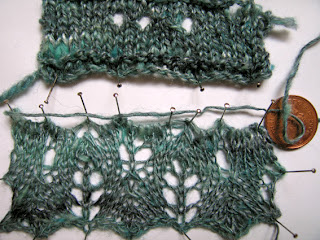
 That's the first repeat plus a bit of the Faux Russian Shawl from Folk Shawls, in Posh Yarn Eva 2-ply. It's a cashmere/silk blend that's as soft as soft can be, in a dusty blue shot with faded green. It's also the first shawl that has forced me to use a lifeline: for some reason I found the first repeat of this pattern very difficult to work. I don't mind the odd half-hour spent dropping a stitch or three to make a correction, but I lost two hours re-working about 60 stitches. That's not entirely the shawl's fault, of course. I might have been a little foolish to attempt to drink wine and watch TV while knitting. The most useful thing was probably my decision to attack the photocopied pattern with coloured pencils to mark the centre line of the main pattern elements as well as every 10th stitch. I now have markers (see them glinting?) to match the pencil lines, so I know immediately if something's awry. Although I do have to shift most markers one stitch on every pattern row, this is still faster than ripping back. And I think the end result is worth it, even unblocked.
There's some frantic knitting that I haven't photographed yet. I desperately want to cast on for another, simpler shawl, but I NEED sweaters. It's cold here. I can knit sweaters, I am a reasoning, reasonably intelligent adult. I can do this. I just have to start. So I started. I've got gauge and have done about 2" of the sleeves (two at once, magic loop) for Autumn Rose (link chosen at random from the many). Ravelry has proven its use once again: someone roughly my bust size has confirmed that the 37" will fit nicely with an inch of negative ease. So, be bold, be bold... but not too bold. I must check my gauge regularly!
And more spinning, on the spindle this time.

some of which I sampled (the colour's more accurate below):
 Top, Andean 2-ply; bottom, the singles. This is most of one of four Mermaid batts from Squoosh. Two or three blue/green wools carded with white silk, the exact colours of a small bay with a white shell-sand beach on the west coast of Scotland... and in my memory. I am trying to spin a soft singles that is consistently thicker than the thin one my hands want to make, which is difficult. I read recently that once you've got the hang of spinning it's easier to spin thin than thick, and I believe it. Periodically there's a little lump of wool that won't draft and passes into the singles to become a textured heathery lump in the yarn, easily seen in the 2-ply sample. Question is, what am I going to do with this? 'Soft' is successful: this is a lovely squozeable yarn, far too soft for socks (my first thought). The heathery 2-ply would be a good sweater fabric, but there won't be enough for that. It's 4.75 oz of fibre. I could knit a comfort shawl with it, something like the Wool Peddler's Shawl would work well. I could save it to combine with something else. I think (what do you think?) I'd be justified in using the singles for lace; the lumps just seem to add character if I use a relatively simple textured stitch such as fir cone. Gah. I'm astonished at how annoyed and frustrated I am, just because I don't know what to do with this pretty yarn. That's not what spinning is for!
Other frantic things you can't see because I won't show them. nyah, nyah. Such as the pile of stuff to be thrown away. I find that when I am truly stressed I still procrastinate, but in ways that reveal the depths of my desperation. I clear shelves, I throw masses of stuff away, hoping perhaps to find some spare time at the bottom of that box of archive images cut from magazines in the days before the internet put entire image libraries at my fingertips. I acknowledge I'm never going to have more than a passing interest in calligraphy, so those photocopied samples of fabulous handwriting can be recycled. My notes for the 'Become Addicted to Landscape History through Hedgerow Dating' courses I taught 10 years ago are surplus to requirements: the space is needed for my fibre stash. I haven't found a cache of spare time (why didn't I put some aside when I was 11 and bored during the endless hot summer holiday?) but I do feel a little lighter and more cheerful as I acknowledge that there are many things I once did that no longer interest me, and others I planned to do that are unlikely to be as absorbing as the many challenges and friends I've found in fibre.
Not merry, because that would require too much energy :-) Anyway I'm better at spinning, knitting and reading than merrymaking, and I'd back him at sitting and reading or watching TV against anyone else in the world. So I splurged and ordered a roast from my favourite butcher (in Ludlow, halfway across Britain. My environmentalist halo is sadly askew), bought several bottles of good wine during the usual shop on Friday morning, then pulled the bedcovers over the house and settled in for some self-indulgence. The international phone lines grew hot yesterday as we chatted with far-flung relatives before eating just a fraction too much Festive Food. We've established our own traditions over the decade in which we've had the Christmas break to ourselves, including a rather eclectic dinner consisting of most of our favourite things. Not many gifts because he's already got his bike and I've already got my Schacht :-) <--- That's a huge grin, by the way. I LOVE this wheel. I'm just glad it's my second wheel, because if I'd learned on it I can't imagine settling for anything less. As it is I am already familiar with the Louet Victoria, it's allowed to flex and creak because it's a travelling wheel. The Schacht is solid, smooth, almost noiseless, and it loves to spin. 
It lives upstairs only because there's so little room in our front room. So on weekends I line up my favourite podcasts (usually about hiking in the UK and US), turn my computer chair from the monitor to the wheel and just... go. I'm currently spinning what I thought was merino/silk bought from Fyberspates at Alexandra Palace but I think the chap misidentified it, as there are intermittent lengths of alpaca. It's spinning quite well regardless, and I may just try navajo plying it to preserve the colour variations, which are gorgeous.

I've just tied my first drive band, too. I searched online for cones or long lengths of appropriate string until I found a blog mentioning that Alden Amos uses string bought from a grocery chain store. So I went for a little one-upmanship by plying some linen from the weaving stash into something of the right thickness, then abusing it a bit until it softened. I don't know if this was a good idea, but it's working! I've just re-read this and, realising that a year ago I didn't have a spinning wheel, scarcely dared ply the peculiar stuff of my drop spindle... I'm impressed. By what I've achieved, but more because thanks to the Internet I know that these achievements have been duplicated or surpassed by many people. Because other people are able to pass on their knowledge and experience via the Internet. It's an amazing world. Thanks, Joanne!
Knitting has made my relative's lives easier, not just because they get hand-knits, but because it's easy to buy yarn. My sister has excellent taste.
 The Inca will probably go back to her as a scarf – it's too warm for England. The Fleece Artist Novasomo seems to be a Somoko version of Nova and will be socks. Of course :-)
In return she and my brother-in-law received a pair of socks each. I sent my brother a sweater knit from an old Rowan pattern, plus a pair of Dashing in Cascade 220. Very fast knit, I just hope they fit. My mother traditionally receives a large box of exceedingly English chocolates, puddings, cakes and so forth.
Alas, my sister actually asked for mittens, but too late for me to knit them in time for Christmas. With over a metre of snow in the last three weeks I think they'll be needing mittens for some time yet! If they get mittens my brother should have mitten, too, so that's three pairs. I've never knitted mittens, but Leena's blog has delighted me for some time. And she sells mitten kits, traditional Finnish designs using wool she's dyed with natural dyestuffs. They look wonderful online and even better in the hand. The wool is softish but sturdy and the colours are stunning. Here's the first pair. I've been bold and altered the thumb pattern to stripes just because I love multi-colour stripes.

My brother-in-law should be worried: his feet are so large that I ran out of yarn before the socks were his preferred length. My husband suggested lace as a solution; my first thought was of stripes and contrasting heels and toes. I plan to knit him socks he can't wear to work :-)
My husband would say so. But what I mean is that I should post more often. All across knitting blogland people are saying the same thing, so it's contagious or seasonal. Knitting gifts takes time. And bits of that cold are still, STILL lingering. I've had a mild sore throat for three weeks now, and at the gym or Pilates all my energy runs away, like water down a drain, about 45 minutes into the session leaving me cold, breathless and struggling just as we approach the most strenuous bit of the workout. It's better than it was, though. I keep telling myself that.
Look, finished knitting! (Note: the colour values in most of these photos are bad even though I've tried to correct them. 'tis the season of bad light.)
 These are gift socks for someone with smaller feet than mine, so my hand does the modelling to show the River Rapids lace pattern from Sockbug. Copper Rose merino/tencel sock yarn from the Woolen Rabbit, toe-up on 2mm needles. The lace pattern is both easily memorised and easily worked out from what you've already knitted, so this is an ideal travelling sock pattern.
More finished knitting!!
 Knot a Knitted Paper Bag, pattern by Setsuko Torii in Interweave Knits Summer 2004. This picture is to show that it does work as a moderately large shapeless bag, and that I'm much, much taller than you thought. The yarns were chosen from Habu's stock at Alexandra Palace in October: they only had enough of the paper moire in these colours, so mine is a bit more mottled than the original. I like it now and may end up liking it even more: the shapelessness is ineffably elegant, quintessentially Japanese, and it will look marvellous with jeans and the right top. I think I have a few right tops :-)
 I used it yesterday as a carry-all for spinning night. The plastic bag visible above contains the fibre shown here, spread over what I laughably think of as a desk.
 That's the stuff I was spinning as I sat by the sea in Scotland in July. I haven't had the heart to spin more of it yet, but I decided to at least find out if the singles were what I'd intended.
 That's a UK 5p, which is roughly the same size as a US dime. Looking at the photo now I feel justified in mentioning that the singles on the spindle are about the same thickness as those in the mini-skein, they just look larger because they're closer to the camera! The skeins have been washed and prepped, and I'll knit samples from them later. The 2-py is as near as anything the 2-ply that I dreamed of making from this fibre, which will be something warm and lacy. I hadn't thought of using the singles, but they're surprisingly even and I've just read a comment that a singles may work very well in lace as the twist is often controlled by the combination of different stitch types. So I'll see what that looks like. What interested me most was the way in which these two skeins show how the twist of the singles is partly undone by plying: the 2-ply is beautifully soft and loose. Important lesson learned!
I'm being reminded of another lesson even as I type: stuff I don't want to do takes longer to accomplish.
Caution: depressing thought ahead!
Most of my interpretive work deals with sites of natural history or archaeological interest, but an acquaintance persuaded me (aka twisted both my arms) to produce some panels about a WWII airfield. The airfield itself is scarcely visible today, having been sold as farmland in the early 1960s, but many of the buildings associated with it survive in the surrounding countryside and the village wants to be sure residents understand this bit of their history. Now, I knew a little about Britain and WWII but not enough to draft anything explaining the significance of this particular airfield, so I've been researching it. Britain was not ready for a war in the air in 1939: they'd only realised Germany was a threat in the early 1930s; prior to that they were preparing to fight France. Again. This was one of many airfields hastily constructed in 1940, where those who'd learnt to fly - in 10 weeks - were taught to fly bombers. And here's where my nebulous general reluctance begins to crystallise, because I now know that the type-written text of the original displays glossed over the facts of WWII. "Bomber Command suffered the heaviest losses of any British unit in the Second World War. Roughly 12,000 aircraft were lost and 55,500 aircrew died: almost 60% of all those who served were killed." Six out of every ten of the smiling faces in the photographs I've been leafing through. I can't gloss over this, and I can't forget it. In my draft the quoted text sits baldly under a photo of young men (and a few young women) in the airfield News Room. And, as I struggle to sort out the rest of the panels, I find myself thinking how different this world might have been if so many young men - of any nationality - with ideals and a clear sense of right and wrong had not died in the two Great Wars.
 That's 120m of soft, shiny thickish laceweight. Four ounces of the premium dark grey roving (70% pygora, 30% merino) became 411m of slightly thicker laceweight:
 Spinning these two yarns was another of those learning experiences. Spun a sort of backward supported longdraw (fibre in my left hand drawing back as the twist enters it while my right hand pinches to stop twist now and then to allow the developing singles to thin as my left hand moves back), the cloud almost spun itself; the smooth glossy fibres just slipped neatly together to become the singles.
 It's perhaps a little thinner than it looks there, although I do have small fingers :-) It's 60-65wpi. I wonder how much yarn I'll get out of 2.4oz?
 What you can't see (well, you can, but it's not obvious) is that I'm spinning that on the high-speed bobbin and the high-speed whorl that I bought last week for the Schacht. Not the highest high-speed bobbin, but it's faster than the fastest shipped with the wheel. I'm getting better at this.
 The difference is more subtle than I'd expected, so I'm glad the change in pattern highlights it. I wanted to learn something else new from this, so I've taken the opportunity to try beading using a crochet hook (8/0 beads and a 0.6mm hook). It's easier than I'd imagined and quite effective although I'm not sure I'll wear it. Next decision comes at the end of the second LoV repeat: I want to go back to the darker red. I could just finish the shawl in it, or perhaps not - I'm not sure there's enough. I am tempted to add a single repeat of another Estonian lace pattern, then revert to the brighter red for the edging. Decisions, decisions.


